MyDealer:
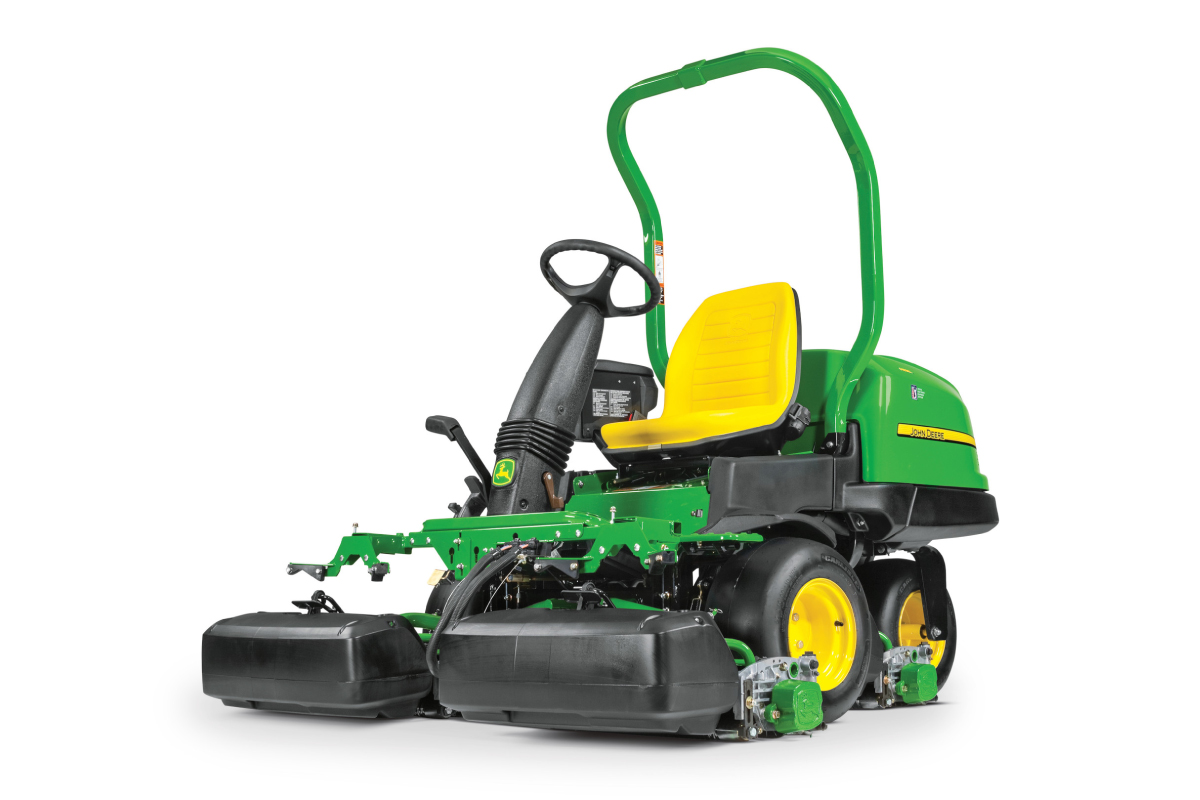
Triplex Mower
- Engine power: 14.6 kW (19.6 hp)
- Cutting width: 157.5 cm (62 in.)
- Reel size: 59.9 cm (22 in.)
- Reel motor: Electric
- Onboard diagnostics: Yes
Features
Electric reel drive system eliminates 102 hydraulic leak points, minimising leak opportunities
Ninety percent of all hydraulic leaks occur in the reel hydraulic circuit, mainly due to the necessity of having flexible hoses extending from the front of the machine for the front reels. These hoses see a lot of flexing during the mowing day as cutting units are raised and lowered. Cutting units also steer and float to follow undulations, increasing fatigue for the reel motor hoses.
The 2550 E-Cut™ Hybrid Triplex Mower has eliminated 102 potential leak points by removing all hydraulics from the cutting unit drive circuit.
This has eliminated the following hydraulic components:
- Reel drive section of hydraulic triple pump
- Hydraulic reel motors
- Backlapping valve
- Hydraulic oil cooler
- Flexible hoses
- Fittings
- Hard lines
Fewer hydraulic components leads to fewer leaks, increasing confidence that the finely manicured turf will not be damaged by hot hydraulic oil spilled onto a playing surface before an important tournament.
Reduced sound levels and reduced fuel consumption at 2250 rpm; throttle notch serves as a guide
The 2550 E-Cut™ Hybrid Triplex Mower is unique because electrical power is used to minimise hydraulic leak opportunities in the reel circuit, but an engine is utilised to ensure optimal performance throughout the day. This presents an opportunity to further enhance machine performance through reduced sound levels and improved fuel savings by running the machine at less-than-full throttle. Scalping and verticutting operations should always be done with the engine at its fullest throttle level.
The 2550 E-Cut Hybrid Triplex Mower can be effectively run in mow at an engine rpm reduced to 2250 rpm. At this operating rpm, the operator may experience up to a 6-dB(A) reduction in sound on diesel machines and 4 dB(A) on gas machines, compared to operating at full throttle. Keep in mind that decibel-amp is measured on a logarithmic curve, so even a 1-dB(A) sound reduction is substantial.
In addition to the reduced sound levels, you may also experience fuel savings as well. Current studies have shown that, depending on conditions and usage, fuel savings can be as high as 30 percent when running the machine at 2250 rpm as opposed to running at full throttle.
To help operators gauge the 2250-rpm level, a throttle notch has been incorporated into the slot for the throttle lever. To approximate 2250 rpm, the bottom edge of the throttle lever should line up with the notch in the throttle lever slot. This will not equate to exactly 2250 rpm, but will get operators close to this level, allowing them to effectively reduce sound levels and decrease fuel consumption during operation.
Brushless electric reel motors for compact design and optimal efficiency
The electric reel motors on the 2550 E-Cut™ Hybrid Triplex Mowers are brushless, allowing them to be compact in size, roughly equal to that of today’s hydraulic reel motors. The brushless motors are very efficient, leading to years of optimal performance with very minimal maintenance, and sealed for protection from the elements.
The motors are bidirectional and variable speed, meaning they can spin forward or reverse and at a range of rotational speeds. The motors spin forward for mowing and scalping operations and backward for verticutting and backlapping operations.
A simple switch on the reel switch box controls the direction of rotation, and a rotary dial on the switch box controls the speed of rotation.
A poly chain belt connects the motor shaft to the reel and rotates the reel when the cutting units are engaged. The internal components of the motor are epoxy sealed for long life, durability, and protection from the elements.
Cutting units are easily removed from the cutting unit motors by loosening the two bolts securing the motor to the cutting unit, turning the motor approximately one-quarter turn, and pulling the motor from the cutting unit. This can be done in a matter of seconds. A tether prevents damage to the wiring harness when the motor is removed.
48-V alternator powers reel drive motors, requiring no additional batteries on unit
The reel circuit is powered by a 48-V, 100-amp alternator belt-driven by the engine. The alternator supplies constant power to the reel circuit and only generates the 48 V when the mow system is engaged.
Due to this design, no additional batteries are required to drive the reel motors on the 2550 E-Cut™ Hybrid Triplex Mower. With traditional electrical mowing systems, the frequency of clip would change as the batteries drained while mowing.
A battery pack begins to lose its power immediately when used, but not on the 2550 E-Cut Hybrid. Since the 2550 E-Cut Hybrid still uses an engine to drive an alternator, the frequency of clip on the first green and the last green are exactly the same, yielding unparalleled quality of cut from start to finish.
Plus, you don’t have to plug the machine in to charge the batteries once your day of mowing is done. The only limitation on run time with the 2550 E-Cut Hybrid is making sure the operator starts the day with a full fuel tank, just like any other gas- or diesel-powered machine on the market today.
The alternator only supplies power to the reel circuit. The remainder of the circuits are powered by the same 12-V battery used on the 2550 PrecisionCut™ Triplex Mower.
Quiet and powerful diesel engine
The 2550 PrecisionCut™ and 2550 E-Cut™ Hybrid Riding Greens Mowers use a 14.6 kW (19.6 hp)* gross (per SAE J1995 at 3000 rpm) liquid-cooled diesel engine for smooth, efficient, and quiet operation.
With the 3-cylinder diesel engine and a large 29.9-L (7.9-U.S. gal.) fuel tank, the 2550 models give the operator power and fuel for a productive day of mowing.
*Engine horsepower and torque information are provided by the engine manufacturer to be used for comparison purposes only. Actual operating horsepower and torque will be less. Refer to the engine manufacturer’s website for additional information.
55.9-cm (22-in.) cutting unit rear-attaching-point yoke kit for fairways, surrounds, and tees
Low weight and compaction of a riding greens mower with the mowing system of a fairway mower equals great quality of cut in fairways and surrounds.
Many golf courses want to mow their fairways and other areas with riding greens mowers as a way to decrease compaction of the turf. However, the front-attaching-point yoke system used for greens is not the ideal solution for other areas due to the mowing speed, and the terrain is not as smooth as a green.
The 55.9-cm (22-in.) cutting unit rear-attaching-point yoke kit attaches to the rear cutting unit to help keep the rear roller on the ground consistently in undulating terrain. This also substantially improves cut quality by maintaining a consistent height of cut in virtually any condition. Rather than pushing the cutting unit through the turf, the yoke system pulls the cutting unit through the turf keeping the back end of the cutting unit engaged with the turf.
14-blade reel lowers frequency of clip
Using the 14-blade reel on greens mowers will lower the frequency of clip and also provide a clean, smooth cut. It can increase the playability of the putting surface and greens speed.
Frequency of clip (FOC) is defined as the distance traveled between consecutive cuts. In other words, it is how far the machine moves from the time one blade passes across the bedknife until the next blade passes. The lower the frequency of clip, the less distance that is traveled until the next blade passes.
There is a point of diminishing returns when it comes to frequency of clip. The less distance the mower travels between consecutive cuts, the more times the same grass blade is going to be impacted by the reel. Too low a frequency of clip can cause bruising of the turf – especially in the overlap from pass to pass.
Frequency of clip is often used as a measurement of cut quality, however there are other key factors that attribute to gaining good quality of cut. The factors that lead to good cut quality are:
- Geometry of the cutting unit
- Sharpness of reels and bedknife
- Proper cutting-unit setup (parallel and bedknife-to-reel clearance)
- Height of cut (HOC) (effective versus bench HOC)
- Bedknife selection
- Roller selection for the turf conditions
- Turf conditions
The geometry of John Deere cutting units makes the optimum range for frequency of clip between 0.160 in. (4.064 mm) and 0.190 in. (4.824 mm) for walk greens mowers. This is where the technology of the PrecisionCut™ walk greens mowers excels and provides a superior cut and after-cut appearance.
Larger, 63.5-mm (2.5-in.) front grooved disc roller compatible with fairway tender conditioner (FTC) and Greens Tender™ conditioner attachment for 55.9-cm (22-in.) Quick-Adjust 5 (QA5) reel cutting units
The grooved disc roller can be used with 55.9-cm (22-in.) QA5 cutting units, in combination with the Greens Tender Conditioner and FTC, to provide additional roller options for fairway, tees, and approach areas.
The increased diameter improves the durability over smaller rollers, and it features hardened discs for improved wear which retains spring tension for reduced maintenance, making it an ideal roller for fairway, tee, and approach mowing.
Looking for another product?